Every business, no matter how profitable, experiences cash flow gaps. Whether it’s covering payroll, purchasing inventory, or taking on new projects, companies often need short-term financing to bridge these gaps. A Ledgered Line of Credit (LLOC) offers a flexible way to access working capital using unpaid invoices as collateral.
Unlike traditional business installment loans, which require fixed payments and often demand physical collateral, an LLOC adjusts dynamically based on a company’s outstanding receivables. This allows businesses to borrow exactly what they need when they need it, making it an ideal solution for those operating on credit terms.
But how does it compare to other financing solutions like business loans, invoice factoring, and merchant cash advances? Let’s explore how a Ledgered Line of Credit works, its advantages, real-world applications, and why it might be the best financing tool for your business.
What is a Ledgered Line of Credit?
A Ledgered Line of Credit (LLOC) is a revolving credit facility that allows businesses to borrow against unpaid invoices on an ongoing basis. Unlike a traditional line of credit with a fixed limit, an LLOC adjusts dynamically as new invoices are generated and old ones are paid.
Key Features of a Ledgered Line of Credit:
- Revolving Credit – Unlike lump-sum loans, an LLOC lets businesses draw funds as needed.
- Invoice-Based Borrowing – Credit is determined by the value of outstanding invoices.
- Repayment Tied to Customer Payments – As customers pay their invoices, the borrowed amount is replenished.
- No Fixed Monthly Payments – Businesses only pay interest on the amount drawn, reducing unnecessary debt.
How Does a Ledgered Line of Credit Work?
- A business issues invoices – After delivering products or services, the company invoices its customers.
- The lender advances funds – The lender provides an agreed percentage (typically 70%-90%) of the invoice value.
- The business uses the funds – Funds can be used for payroll, inventory, expansion, or operational expenses.
- Customers pay their invoices – The credit line is replenished as the business makes loan payments when its customers settle their invoices.
- The business borrows again as needed – The process repeats, providing ongoing access to working capital.
Example Scenario: A Manufacturing Company
A mid-sized manufacturing company frequently invoices customers with 90-day payment terms. This creates a cash flow gap, as the company needs funds to purchase raw materials and pay employees.
- Instead of waiting for payments, the company uses an LLOC to borrow against outstanding invoices.
- The lender provides 85% of the invoice value upfront, allowing the company to cover expenses.
- When customers pay the invoices, the business repays the borrowed amount, replenishing the credit line.
This ensures the company has continuous access to funds without disrupting operations.
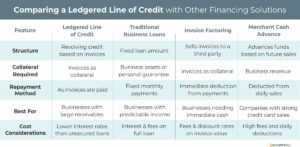
Comparing Other Options
- Traditional Business Loans
- Fixed-term loans provide a lump sum that must be repaid with interest over time.
- This arrangement is not ideal for companies with fluctuating cash flow, as payments remain fixed regardless of revenue.
- Invoice Factoring
- Involves selling invoices to a factoring company at a discount in exchange for immediate cash.
- Unlike an LLOC, the factor becomes responsible for collecting the payment of receivables.
- Merchant Cash Advances (MCA)
- Provides a cash advance in exchange for a percentage of daily sales.
- MCAs are one of the most expensive financing options, often resulting in high fees and long-term financial strain.
Why a Ledgered Line of Credit Stands Out
- No fixed monthly payments – Unlike loans, businesses repay when invoices are paid.
- Maintains control of receivables – Unlike factoring, businesses retain control of collections.
- Lower fees than MCAs – Costs are typically lower than merchant cash advances, which have triple-digit APRs.
Who Should Consider a Ledgered Line of Credit?
Best Suited for:
- B2B Companies – Businesses that operate on net 30, 60, or 90-day payment terms.
- Companies with large receivables – Businesses with high invoice volumes can access more capital.
- Growing businesses – Expanding operations require flexible, scalable funding solutions.
- Companies facing seasonal fluctuations – An LLOC ensures year-round access to working capital.
Not Ideal for:
- Businesses without receivables – Companies that don’t invoice customers can’t leverage LLOCs.
- Cash-heavy businesses – Traditional credit lines may be sufficient if a company doesn’t face cash flow gaps,.
How to Get Started with a Ledgered Line of Credit
- Assess Your Accounts Receivable
- Ensure your invoicing process is structured and reliable.
- Find a Lender Specializing in LLOCs
- Not all lenders offer LLOCs; look for those with experience in invoice-backed lending.
- Understand the Terms & Fees
- Compare interest rates, advance percentages, and repayment structures.
- Maintain Strong Invoice Management
- Faster-paying customers result in better liquidity and higher credit availability.
- Use Funds Strategically
- Prioritize cash flow needs such as payroll, inventory, and operational costs.
Real-World Example: A Logistics Company
A logistics and freight company operates on 60-day invoice terms but must pay drivers and fuel costs weekly.
- By using an LLOC, the company borrows against outstanding invoices, ensuring steady cash flow.
- As customers pay their invoices, the credit line replenishes, allowing the company to reinvest in operations.
- This eliminates the need for high-interest loans or disruptive factoring arrangements.
Conclusion
A Ledgered Line of Credit is a cost-effective, scalable, and flexible alternative to traditional loans, invoice factoring, and merchant cash advances. By leveraging unpaid invoices, businesses can access working capital on demand without high interest rates or rigid repayment schedules.
If you’re looking for a financing tool that adapts to your business cycle, an LLOC might be the perfect solution. Explore your options today and take control of your cash flow with confidence.
Contact us to discover fast, convenient cash flow solutions that maximize access to credit and optimize working capital management to stabilize financial structures and support growth.
Key Takeaways
- SMBs seeking business financing typically benefit from choosing a cost-effective, scalable, and flexible alternative to traditional term loans.
- A Ledgered Line of Credit (LLOC) is a revolving credit facility allowing businesses to borrow against outstanding invoices.
- This flexible financing option provides funds as needed, reducing unnecessary debt. The borrowing company only pays interest on the amount drawn.
- LLOC is a fast funding solution to close funding gaps that adapts to your business cycle without high-interest rates or rigid repayment schedules.
ABOUT eCapital
At eCapital, we accelerate business growth by delivering fast, flexible access to capital through cutting-edge technology and deep industry insight.
Across North America and the U.K., we’ve redefined how small and medium-sized businesses access funding—eliminating friction, speeding approvals, and empowering clients with access to the capital they need to move forward. With the capacity to fund facilities from $5 million to $250 million, we support a wide range of business needs at every stage.
With a powerful blend of innovation, scalability, and personalized service, we’re not just a funding provider, we’re a strategic partner built for what’s next.