Companies with unique financial profiles, poor credit ratings, or complex assets face a challenging task when attempting to raise capital through traditional financing arrangements. Businesses with complex financial needs or those in high-risk industries might struggle to meet the stringent requirements of conventional loans. Additionally, companies with non-standard business models or those in emerging markets may find that traditional financing options do not adequately address their specific requirements, prompting them to turn to structured financing solutions that offer more flexibility and tailored terms.
Structured financing is a specialized and complex method of raising capital by leveraging non-standard assets, complex instruments, and tailored financial structures. This financing approach is especially useful for companies with intricate financial needs, enabling them to achieve their objectives while managing risks effectively.
In this blog, we’ll explore the mechanics of structured financing, its benefits, and how it is reshaping the way businesses address their financial challenges.
What Is Structured Financing?
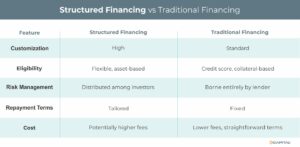
This type of financing refers to a set of sophisticated financial instruments customized to meet specific funding requirements. Unlike conventional loans or equity financing, this type of financing often involves complex arrangements such as asset-backed securities, collateralized debt obligations, or mezzanine financing.
The following lists the key features associated with this type of financing:
- Customization: Tailored to align with a company’s financial strategy and unique needs.
- Asset Utilization: Often uses specific assets or revenue streams as collateral or security.
- Risk Management: Structured to manage and distribute financial risk effectively.
How Does Structured Financing Work?
- Assessment: Financial experts analyze the company’s needs, asset base, and cash flow to design a solution.
- Structuring: A financing package is created, potentially involving a combination of debt, equity, and hybrid instruments.
- Execution: The structured finance solution is implemented, enabling the company to access the required capital.
- Repayment and Monitoring: Repayments are made according to the customized terms, which may include flexible schedules or revenue-based payments.
Types of Structured Financing Instruments
- Asset-Backed Securities (ABS): Financial instruments backed by assets such as loans, leases, or receivables. Companies can convert future cash flows into immediate capital.
- Collateralized Debt Obligations (CDOs): Securities backed by a diversified pool of debt obligations, offering investors varying levels of risk and return.
- Securitization: Pooling financial assets and selling them as securities to investors, allows businesses to unlock liquidity from assets.
- Mezzanine Financing: A hybrid between debt and equity that provides capital in exchange for equity interest or convertible debt.
- Structured Credit Products: Custom-built credit instruments designed for risk-sharing and capital optimization.
Benefits of Structured Financing
- Access to Capital
- Provides funding for large-scale or complex projects that may not qualify for traditional financing.
- Enhanced Liquidity
- Converts illiquid assets into cash, improving a company’s working capital position.
- Flexibility
- Tailored structures allow businesses to design repayment terms that align with cash flow and operational goals.
- Risk Mitigation
- Structured solutions help distribute and manage financial risks, reducing exposure for the company and its investors.
- Cost Efficiency
- Often more cost-effective than equity financing, as structured financing minimizes ownership dilution.
Industries Leveraging Structured Financing
- Real Estate
Real estate developers use structured financing to fund large-scale developments, leveraging assets like properties or future rental income as collateral.
- Energy
Energy companies finance renewable energy projects or infrastructure development by securitizing long-term contracts or revenue streams.
- Transportation
Airlines and shipping companies use this type of financing to fund fleet expansions by securitizing future ticket sales or cargo contracts.
- Technology
Tech startups utilize mezzanine financing to bridge funding gaps while retaining control over operations.
- Manufacturing
Manufacturers use structured financing to fund machinery purchases or production expansions backed by receivables or inventory.
Challenges in Structured Financing
- Complexity
- The arrangements require specialized expertise and thorough analysis, making the process time-intensive.
- Regulatory Compliance
- Structured financing often involves navigating complex regulatory frameworks, which can vary by jurisdiction.
- Higher Costs
- While cost-effective in some cases, this type of financing can involve higher upfront fees and management costs.
- Market Dependency
- The success of certain instruments, like securitization, depends on market conditions, which can introduce unpredictability.
When Should Businesses Consider Structured Financing?
This type of financing is ideal for businesses when:
- Unique Needs Exist: Traditional loans or equity financing don’t align with their requirements.
- Large Capital Is Needed: Major projects, acquisitions, or expansions require significant funding.
- Assets Are Available: The company has valuable assets or revenue streams that can be leveraged.
- Risk Management Is a Priority: The business seeks to distribute financial risk among multiple stakeholders.
Real-World Example
Scenario: A renewable energy company plans to build a wind farm but requires $50 million in upfront capital.
Solution: The company uses structured financing by securitizing long-term power purchase agreements (PPAs) with energy buyers. The proceeds from the securitization fund the construction, while investors benefit from predictable returns tied to the PPA revenue.
Outcome: The company accesses capital without taking on traditional debt or diluting ownership while managing risk effectively.
Conclusion
Structured financing is a powerful tool that empowers businesses to achieve their financial and operational goals through innovative, customized solutions. By leveraging assets, managing risks, and accessing large-scale funding, structured financing can open doors that traditional financing cannot.
However, its complexity demands expertise and careful planning. Businesses considering this type of financing should consult financial advisors or specialized institutions to ensure the solution aligns with their strategic objectives.
Contact us whether you’re expanding operations, launching a large-scale project, or optimizing your financial strategy. eCapital can structure a financing arrangement to help you unlock your business’s full potential.
Key Takeaways
- Businesses with complex financial needs or those in high-risk industries might struggle to meet the stringent requirements of conventional loans.
- Structured financing is a specialized method of raising capital especially useful for companies with intricate financial needs, enabling them to achieve their objectives while managing risks effectively.
- By leveraging assets, managing risks, and accessing large-scale funding, structured financing can open doors that traditional financing cannot.
ABOUT eCapital
At eCapital, we accelerate business growth by delivering fast, flexible access to capital through cutting-edge technology and deep industry insight.
Across North America and the U.K., we’ve redefined how small and medium-sized businesses access funding—eliminating friction, speeding approvals, and empowering clients with access to the capital they need to move forward. With the capacity to fund facilities from $5 million to $250 million, we support a wide range of business needs at every stage.
With a powerful blend of innovation, scalability, and personalized service, we’re not just a funding provider, we’re a strategic partner built for what’s next.