Managing inventory is a critical aspect of business operations, especially for industries that rely heavily on large stock volumes. However, maintaining high inventory levels can strain a company’s cash flow, leaving little room for other operational needs. Warehouse financing offers a smart solution, enabling businesses to leverage their inventory as collateral to secure funding.
This blog explores warehouse financing, how it works, its benefits, and how businesses can use it to optimize inventory management and cash flow.
What Is Warehouse Financing?
Warehouse financing is a type of inventory financing that allows businesses to borrow funds against their stored inventory. By using inventory as collateral, businesses can access working capital to cover operational expenses, purchase additional stock, or invest in growth opportunities—all while keeping their inventory intact and operational.
Key Features of Warehouse Financing:
- Inventory-Based: Loans are secured by unincumbered inventory held in storage facilities or warehouses.
- Flexible Usage: Funds can be used for various operational needs, including payroll, supplier payments, or seasonal stock purchases.
- Third-Party Management: Often involves a third-party warehouse operator that verifies and manages the inventory.
How Does Warehouse Financing Work?
- Inventory Valuation: The business provides details about the inventory to be used as collateral. A third-party warehouse or lender appraises the stock to determine its value.
- Loan Approval: The lender approves a loan amount based on a percentage (typically 50%-75%) of the inventory’s assessed value.
- Warehouse Management: The lender may require the inventory to be stored in a bonded or controlled warehouse, with the lender maintaining oversight. Alternatively, the borrower may be able to store inventory at their own facility, but the lender may require third-party verification or insurance to ensure proper management and security of the goods.
- Fund Disbursement: Once approved, funds are disbursed to the borrower for immediate use.
- Repayment: The borrower repays the loan, often aligned with the sale or turnover of the inventory.
Who Can Benefit from Warehouse Financing?
Warehouse financing is ideal for businesses that:
- Manage large inventories and need capital for operational or growth needs.
- Experience seasonal cash flow fluctuations and require funding to stock up for peak seasons.
- Operate in industries with long sales cycles and need interim financing to bridge cash flow gaps.
- Seek alternative financing options that don’t involve selling equity or fixed assets.
Benefits of Warehouse Financing
- Improved Cash Flow
- Converts tied-up inventory into liquid capital, enabling businesses to cover day-to-day expenses.
- Retained Inventory Ownership
- Businesses retain ownership and control over their inventory while accessing needed funds.
- Flexible Loan Terms
- Loans are structured to align with inventory turnover and business cash flow cycles.
- Scalable Financing
- Funding grows with inventory levels, providing additional capital as needed.
- Supports Growth
- Enables businesses to invest in expansion, new products, or seasonal stocking without depleting reserves.
- Cost-Effective
- The secured nature of the loan often results in lower interest rates compared to unsecured options.
Challenges of Warehouse Financing
- Inventory Management Costs
- Storing inventory in a third-party warehouse, engaging in third-party verification, and maintaining required insurance can incur additional expenses.
- Valuation Fluctuations
- Inventory value may fluctuate due to market conditions, affecting the loan amount or terms.
- Limited Asset Applicability
- Only businesses with significant or valuable inventory are eligible.
- Risk of Default
- Failure to repay the loan could result in the lender liquidating the inventory.
- Compliance Requirements
- Businesses may need to adhere to stringent tracking and reporting standards for inventory under financing.
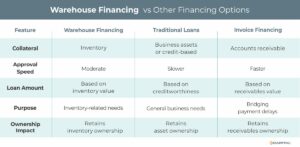
Industries That Benefit from Warehouse Financing
- Retail and E-Commerce
- Manage large stock volumes during seasonal peaks or promotional periods.
- Manufacturing
- Fund raw material purchases or finished goods storage.
- Wholesale and Distribution
- Bridge cash flow gaps while holding inventory for large-scale clients.
- Agriculture
- Finance seasonal storage of grains, produce, or other commodities.
- Pharmaceuticals
- Maintain adequate inventory levels to meet regulatory and market demands.
Real-World Example: Warehouse Financing in Action
Scenario: A mid-sized wholesale distributor of electronics has $3 million worth of inventory stored in a warehouse but needs a significant injection of cash to stock up on the latest models, pay for additional storage space, and cover employee overtime ahead of the holiday season.
Solution: The distributor secures warehouse financing, using the current inventory as collateral. The lender approves a loan covering 75% of the inventory’s value, disbursing $2,250,000.
Outcome: The distributor uses the funds to purchase additional stock, meets the increased holiday demand, and repays the loan with proceeds from the sales, ensuring profitability and continued growth.
How to Use Warehouse Financing Strategically
- Anticipate Seasonal Demand
- Use financing to stock up inventory ahead of high-demand periods.
- Monitor Inventory Turnover
- Ensure that financed inventory moves quickly to minimize repayment risks.
- Align Funding with Sales Cycles
- Structure repayments to coincide with expected revenue streams.
- Work with Trusted Lenders
- Look for leading specialty lenders offering transparent terms and competitive interest rates. Visit their company websites and read customer reviews to evaluate satisfaction and reliability. Partner with a reputable lender whose organization and work practices aligns with your company’s nee
- Leverage Third-Party Warehouses
- Use bonded warehouses to manage and verify inventory, simplifying the financing process.
Tips for Choosing a Warehouse Financing Provider
- Evaluate Costs
- Review interest rates, storage fees, and other associated costs.
- Check Loan-to-Value Ratios
- Ensure the percentage of inventory value covered by the loan meets your financial needs.
- Understand Terms
- Confirm repayment schedules and any penalties for default or early repayment.
- Assess Flexibility
- Choose a lender offering scalable financing options to accommodate inventory fluctuations.
- Ensure Strong Inventory Management
- Keep accurate records and tracking systems to simplify inventory verification.
Conclusion
Warehouse financing is a valuable tool for businesses seeking to manage inventory effectively, improve cash flow, and seize growth opportunities. By leveraging the value of their inventory, businesses can access the capital needed to stay competitive and navigate financial challenges without compromising operations.
If your business is inventory-dependent and needs flexible, inventory-based funding, warehouse financing could be the solution. Evaluate your needs, research reputable providers, and use this strategic financing option to unlock the potential of your inventory and drive success.
Contact us to explore the many business financing solutions available to ensure reliable cash flow and easy access to working capital.
Key Takeaways
- Maintaining high inventory levels can strain a company’s cash flow, leaving little room for other operational needs.
- Warehouse financing offers a smart solution, enabling businesses to leverage their inventory as collateral to secure funding.
- Using inventory as collateral enables businesses to access working capital to cover operational expenses, purchase additional stock, or invest in growth opportunities—all while keeping their inventory intact and operational.
ABOUT eCapital
At eCapital, we accelerate business growth by delivering fast, flexible access to capital through cutting-edge technology and deep industry insight.
Across North America and the U.K., we’ve redefined how small and medium-sized businesses access funding—eliminating friction, speeding approvals, and empowering clients with access to the capital they need to move forward. With the capacity to fund facilities from $5 million to $250 million, we support a wide range of business needs at every stage.
With a powerful blend of innovation, scalability, and personalized service, we’re not just a funding provider, we’re a strategic partner built for what’s next.