
Owning a trucking company is about far more than moving freight from point A to point B. Every mile you run carries legal responsibility for safety, trucking compliance, contracts, employees, and the public at large. Tort costs (economic costs arising from lawsuits or insurance claims) are growing faster in the commercial transportation liability space than in other areas, increasing at about 10% annually. For owner-operators and fleet owners alike, legal exposure is one of the most underestimated threats to long-term profitability and survival.
Understanding the legal implications of operating a trucking business, building systems to proactively manage trucking compliance requirements, and fortifying financial structures can mean the difference between a resilient operation and one derailed by fines, lawsuits, or insurance claims.
In trucking, disciplined risk management, supported by adequate insurance and strong cash flow, is essential to long-term sustainability. This article is part of a guide designed to provide fleet owners and managers with actionable financial strategies to enhance operational reliability and profitability.
About the guide: A Trucker’s Guide to Cash Flow Management is a strategy blueprint and best-practice resource designed to help fleet owners and managers optimize working capital, control costs, and build financially resilient operations that keep trucks moving and business profitable.
This article breaks down the major legal risks trucking companies face, how to protect your business, and how to manage legal expenses without letting them spiral out of control.
The legal landscape of owning a trucking company
Trucking is one of the most heavily regulated industries in North America, making trucking compliance a central operational priority. Operators must comply with federal, state, and sometimes local regulations, while also navigating private contracts and civil liability.
Key areas of legal exposure include:
- Regulatory compliance
- Safety and accident liability
- Employment and labor law
- Contractual obligations
- Insurance and risk transfer
Each area carries distinct risks, but they are deeply interconnected. A breakdown in one often triggers problems in others.
Regulatory compliance: The foundation of legal protection
Trucking compliance failures are among the fastest ways to attract fines, audits, and lawsuits.
Trucking companies must comply with regulations covering:
- Driver qualifications and licensing
- Hours of Service (HOS) rules
- Vehicle inspections, maintenance, and repair
- Drug and alcohol testing
- Recordkeeping and reporting
Breakdowns in trucking compliance don’t just lead to penalties – they can be used as evidence of negligence in civil litigation. After an accident, plaintiff attorneys routinely scrutinize compliance records looking for violations that strengthen their case.
How to reduce risk:
- Maintain meticulous records for drivers, equipment, inspections, and maintenance.
- Use ELDs and fleet management software to automate compliance tracking.
- Conduct internal audits before regulators do.
- Treat trucking compliance as an operational system, not just paperwork.
A clean compliance record doesn’t eliminate risk, but it dramatically improves your legal standing when something goes wrong.
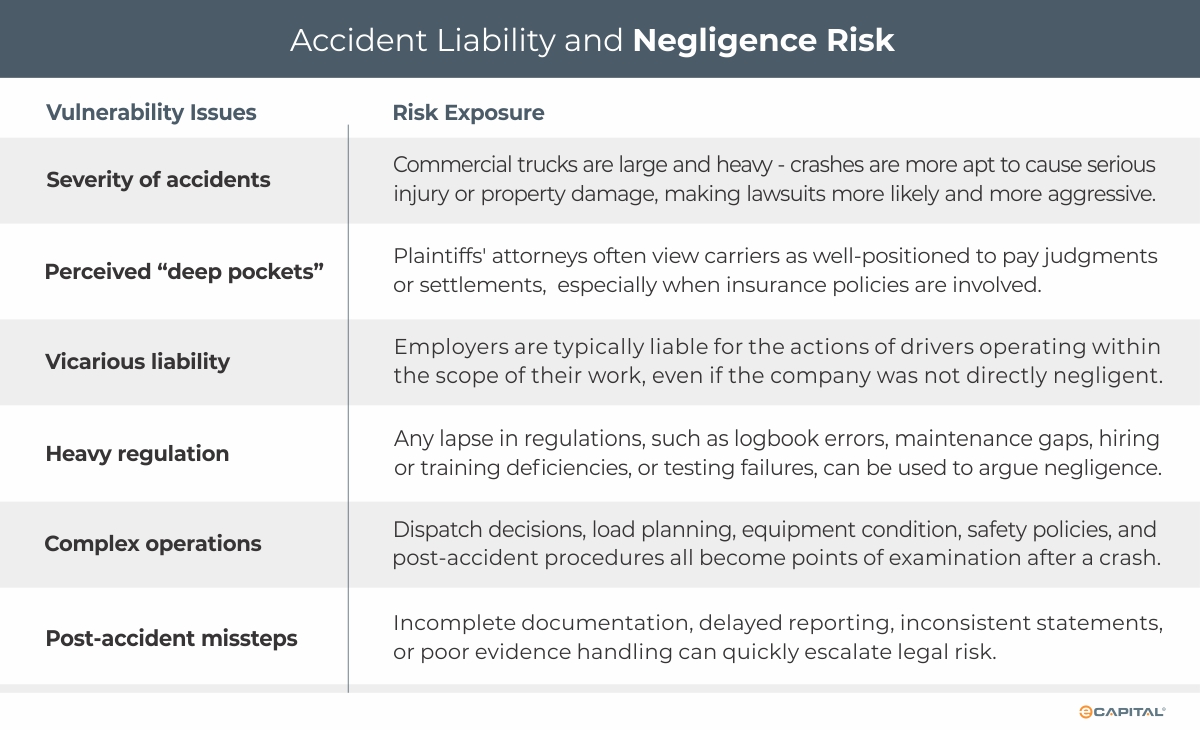
Accident liability and negligence risk
Accidents are an unfortunate reality in trucking, even for well-run operations. The extent of legal risk often lies in what happens next. Effective post-accident crash management is essential.
When a collision occurs, liability may extend to:
- The driver
- The trucking company
- Maintenance providers
- Shippers or brokers (in some cases)
Trucking companies are often legal targets because accidents involving commercial vehicles often result in significant damages, clear corporate responsibility, and multiple avenues of liability. Lawsuits may allege negligent hiring, negligent training, improper maintenance, or failure to supervise drivers.
Risk-reduction strategies include:
- Robust driver screening and ongoing training.
- Clear safety policies with documented enforcement.
- Preventive maintenance programs with proof of execution.
- Telematics and dash cameras to provide objective data.
Documentation is critical. In matters of trucking compliance and accident defense, if it isn’t written down, it didn’t happen in the eyes of a courtroom. Legal risk often stems less from the crash itself and more from how well, or poorly, the business demonstrates control, compliance, and discipline before and after the incident.
 Employment law: Drivers, contractors, and classification risk
Whether drivers are classified as employees or independent contractors has major legal and financial consequences.
Misclassification can trigger:
- Back wages and overtime claims
- Tax penalties
- Workers’ compensation exposure
- Class-action lawsuits
As regulations evolve, especially around independent contractor status, trucking companies must stay current and conservative in their classifications to maintain trucking compliance.
Best practices include:
- Working with experienced legal counsel to structure driver relationships correctly.
- Using well-drafted contracts that reflect actual working arrangements.
- Avoiding “control creep” that undermines contractor status.
- Staying current with state-specific labor laws.
Employment-related lawsuits can be some of the most expensive and disruptive legal challenges a trucking company faces.
Contracts: Where many legal problems begin
Every trucking company relies on contracts – broker agreements, shipper contracts, lease agreements, and vendor arrangements. Poorly drafted or poorly understood contracts are a common source of legal disputes.
Problematic contract issues include:
- Unfavorable indemnification clauses
- One-sided liability provisions
- Payment terms that increase cash-flow strain
- Ambiguous service obligations
Many operators sign contracts under pressure to keep trucks moving, without fully understanding the legal exposure they’re assuming.
To protect your business:
- Have contracts reviewed by legal counsel familiar with transportation law.
- Standardize contract review procedures.
- Avoid agreements that shift excessive liability onto your company.
- Align contract terms with insurance coverage.
Strong contracts don’t eliminate disputes, but they reduce ambiguity and improve your negotiating position if one arises.
Insurance: Your first line of legal defense
Insurance is not just a financial tool – it’s a legal shield.
Trucking companies typically carry:
- Auto liability insurance
- Cargo insurance
- Physical damage coverage
- Workers’ compensation
- General liability
Inadequate coverage or coverage gaps can expose owners directly to lawsuits and judgments.
Key considerations:
- Ensure policy limits reflect your risk profile and lanes.
- Understand exclusions and endorsements.
- Review policies annually as operations change.
- Coordinate insurance coverage with contract obligations.
Rising litigation costs and large jury verdicts have made insurance both more expensive and more critical. Reactive decisions to cut corners often backfire. Instead, consider strategies to lower premiums without compromising coverage.
Managing legal expenses without losing control
Legal costs can escalate quickly – especially during audits, accidents, or litigation. The goal isn’t to eliminate legal expenses, but to manage them predictably.
Smart cost-management strategies include:
- Preventive legal planning instead of reactive firefighting.
- Retaining counsel familiar with trucking regulations.
- Using standardized policies and procedures to reduce disputes.
- Resolving minor issues early before they escalate.
Cash-flow strain often makes legal problems worse. When companies delay addressing trucking compliance gaps, contract disputes, or employment issues because of cash constraints, the eventual cost is usually far higher.
Why cash flow stability matters in legal risk management
Legal protection requires consistency – consistent maintenance, consistent payroll, consistent insurance coverage, and consistent compliance. All of that depends on reliable cash flow.
Delayed customer payments can force operators into risky decisions:
- Deferring maintenance
- Cutting safety corners
- Letting insurance lapse
- Ignoring legal issues until they explode
Strong cash-flow management allows trucking companies to:
- Pay legal and compliance expenses on time.
- Invest in preventive systems.
- Respond quickly to regulatory or legal challenges.
- Avoid reactive, high-risk decisions.
In this sense, liquidity is a form of legal protection. It gives owners options when pressure mounts. Two mainstream cash flow solutions commonly used in the trucking industry to improve liquidity are freight factoring and asset-based lending.
Building a legally resilient trucking business
Legal resilience isn’t built overnight. It’s the result of disciplined operations, proactive planning, and financial stability.
The strongest trucking companies:
- Treat trucking compliance as a core operating function.
- Document safety, training, and maintenance rigorously.
- Use contracts strategically, not casually.
- Align insurance coverage with real risk.
- Maintain predictable access to working capital.
Legal risk will never disappear from trucking – but it can be managed, contained, and controlled.
Conclusion
Owning a trucking company means accepting legal responsibility for people, equipment, cargo, and public safety. Ignoring that reality doesn’t reduce risk – it amplifies it.
By understanding the legal implications of your operation, investing in preventive trucking compliance systems, and maintaining stable cash flow, you can protect your business from costly surprises and create a more resilient, professional operation.
Legal discipline, like financial discipline, doesn’t just prevent failure – it creates a competitive advantage.
Contact us to explore our flexible funding strategies to support disciplined operations, proactive planning, and financial stability.
Next in the series
Trucking Taxes – Strategic Planning to Protect Cash Flow and Improve Profitability
- Many trucking companies leave money on the table simply because deductions are missed, poorly documented, or misunderstood.
- Understanding how trucking-specific tax deductions work, building systems to capture them consistently, and aligning tax strategy with cash flow management can materially improve financial stability.
- The most effective tax strategies start with understanding which expenses are deductible and how they impact cash flow.
View the complete Table of Contents.
Key Takeaways
- For owner-operators and fleet owners alike, legal exposure is one of the most underestimated threats to long-term profitability and survival.
- Legal costs are growing faster in the commercial transportation liability space than in other areas, rising about 10% annually.
- Understanding the legal implications of your operation, investing in preventive trucking compliance systems, and maintaining stable cash flow protects your business from costly surprises and creates a more resilient, professional operation.
ABOUT eCapital
At eCapital, we accelerate business growth by delivering fast, flexible access to capital through cutting-edge technology and deep industry insight.
Across North America and the U.K., we’ve redefined how small and medium-sized businesses access funding—eliminating friction, speeding approvals, and empowering clients with access to the capital they need to move forward. With the capacity to fund facilities from $5 million to $250 million, we support a wide range of business needs at every stage.
With a powerful blend of innovation, scalability, and personalized service, we’re not just a funding provider, we’re a strategic partner built for what’s next.