The U.S. economy is slowing in 2025, with growth forecast to ease to around 1.6%, notably down from 2024 levels. Headwinds—including rising tariffs, tighter fiscal policies, and weakening consumer spending—are dampening economic momentum. While a recession isn’t expected, inflation remains a persistent concern. As business opportunities tighten in a contracted economy, companies often face the challenge of maintaining cash flow while continuing to invest in growth. Following years of economic uncertainty and credit restrictions by traditional lenders, progressive companies are seeking innovative solutions to fund expansion.
One such solution is the use of sale-leaseback agreements. This innovative financial strategy allows businesses to unlock the value of their assets without relinquishing their use. This comprehensive guide explores the mechanics, benefits, and strategic applications of sale-leasebacks.
What Is a Sale-Leaseback?
A sale-leaseback is a financial transaction where a business sells an asset—typically real estate, equipment, or other high-value property—to a buyer and simultaneously leases it back. The seller becomes the lessee, and the buyer becomes the lessor, allowing the business to continue using the asset while freeing up the capital tied to it.
How Does a Sale-Leaseback Work?
- Asset Valuation: The asset is appraised to determine its fair market value.
- Agreement Terms: The seller and buyer negotiate the sale price, lease terms, and duration.
- Transaction Completion: Ownership of the asset transfers to the buyer, and the seller receives a lump sum payment.
- Leaseback Period: The seller (now lessee) pays rent to the buyer (now lessor) based on the agreed terms, continuing to use the asset.
Key Benefits of a Sale-Leaseback
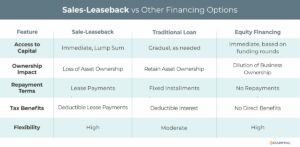
- Immediate Access to Capital
- Businesses can unlock the equity tied up in owned assets, providing an influx of cash for working capital, debt repayment, or growth initiatives.
- Retention of Asset Use
- Companies continue to use the asset as before the transaction, ensuring no disruption to operations.
- Improved Balance Sheet
- Converting a fixed asset into cash can enhance liquidity metrics and reduce debt-to-equity ratios, potentially improving creditworthiness.
- Tax Advantages
- Lease payments are typically tax-deductible as operating expenses, providing potential tax savings compared to depreciation of the asset.
- Strategic Flexibility
- Capital freed from the sale can be redirected into high-return investments, mergers, acquisitions, or other strategic initiatives.
Industries Benefiting From Sale-Leasebacks
- Retail and Hospitality
- Retailers and hotel operators often use sale-leasebacks for real estate assets, enabling them to reinvest in expansion or renovate existing properties.
- Transportation and Logistics
- Companies can monetize fleet vehicles, warehouses, or distribution centers to enhance cash flow while maintaining operational capacity.
- Manufacturing
- Sale-leasebacks of equipment and facilities help manufacturers invest in technology upgrades or expand production capabilities.
- Healthcare
- Hospitals and clinics leverage sale-leasebacks for medical facilities and equipment to fund growth or improve patient care services.
Considerations Before Entering a Sale-Leaseback
- Long-Term Costs
- While the immediate cash influx is appealing, businesses must account for lease payments over time, which may exceed the cost of ownership in the long run.
- Loss of Ownership
- Selling an asset relinquishes control and eliminates potential appreciation in value.
- Lease Terms
- Negotiating favorable lease terms, including rent escalation clauses, maintenance responsibilities, and renewal options is critical.
- Impact on Operations
- Ensure the buyer aligns with the business’s operational needs to avoid potential disruptions.
Example Applications of Sale-Leasebacks
Case Study 1: A Retail Chain Expanding Operations
A retail company sold its owned storefronts to a real estate investment firm and leased them back. The $20 million capital generated funded the opening of new locations in high-growth markets, driving a 30% increase in revenue within two years.
Case Study 2: A Manufacturer Upgrading Technology
A manufacturing firm conducted a sale-leaseback of its factory to raise $5 million for state-of-the-art equipment. The investment boosted production efficiency by 25% and positioned the company as an industry leader.
Trends Shaping the Future of Sale-Leasebacks
- Rising Interest Rates
- As credit restrictions from traditional lenders continue to hinder the growth of SMBs, sale-leasebacks are becoming an increasingly appealing alternative to conventional loans.
- Increased Investor Interest
- Real estate investment trusts (REITs) and private equity firms are increasingly interested in sale-leasebacks, offering competitive terms to businesses.
- Sustainability Investments
- Businesses are leveraging sale-leasebacks to fund green initiatives, such as renewable energy projects and eco-friendly upgrades.
Conclusion
Sale-leasebacks offer businesses a unique opportunity to unlock capital while retaining the operational benefits of their assets. Whether you’re looking to fund growth, improve liquidity, or gain financial flexibility, this strategy can be a game-changer. However, evaluating the long-term implications and choosing an experienced specialty lender to help guide strategic decisions and facilitate access to reliable cash flow is essential.
If your business is considering a sale-leaseback, consult financial advisors and real estate experts to structure a deal that aligns with your goals. With the right approach, sale-leasebacks can be a powerful tool to drive success in today’s competitive market.
Contact us today to learn how we can improve your company’s financial health with flexible financing options to enhance cash flow and support growth.
Key Takeaways
- Following years of economic uncertainty and credit restrictions by traditional lenders, progressive companies are seeking innovative solutions to fund expansion.
- One such solution is the use of sale-leaseback agreements, a financial transaction where a business sells an asset to a buyer and simultaneously leases it back.
- A sale-leaseback offers businesses immediate capital, continued asset use, improved balance sheets, tax benefits, and strategic flexibility.
- Consult experienced financial advisors and specialty lenders to structure a deal that aligns with your goals.
ABOUT eCapital
At eCapital, we accelerate business growth by delivering fast, flexible access to capital through cutting-edge technology and deep industry insight.
Across North America and the U.K., we’ve redefined how small and medium-sized businesses access funding—eliminating friction, speeding approvals, and empowering clients with access to the capital they need to move forward. With the capacity to fund facilities from $5 million to $250 million, we support a wide range of business needs at every stage.
With a powerful blend of innovation, scalability, and personalized service, we’re not just a funding provider, we’re a strategic partner built for what’s next.