

TL;DR:
Amazon sellers often experience rising sales while simultaneously facing greater pressure on working capital as payout cycles lag. This lag often creates cash flow gaps requiring external financing to maintain momentum and support growth. Short-term funding provides a structured framework for accessing working capital through fixed borrowing limits and predetermined repayment schedules. This arrangement can provide much-needed liquidity to address immediate funding needs, but its fixed capacity may become a constraint as inventory requirements grow. In contrast, Liquid Inventory offers a specialized Amazon seller financing solution designed to help fund inventory growth, preserve cash flow, and scale more effectively. While traditional short-term funding is often used for a variety of operational needs, Liquid Inventory is purpose-built for sellers who need ongoing access to capital to support growth as the business scales.
Growing an Amazon business often requires a constant balancing act between investing in inventory and preserving cash flow. When the time comes to fund a major restock, capitalize on seasonal demand, or expand into new product lines, many sellers face an important financing decision. Should they pursue a conventional short-term funding solution or explore a specialized lending option such as Liquid Inventory as part of their Amazon seller financing strategy?
While both approaches can provide access to working capital, they serve different purposes and are designed for different business needs. Understanding the strengths and limitations of each can help sellers make a more informed financing decision to overcome cash flow gaps.
Why Amazon Sellers Run Into Cash Flow Gaps
Cash flow challenges are common in ecommerce, even for profitable businesses. Amazon sellers often need to pay suppliers weeks or months before inventory is received, listed, sold, and ultimately paid out.
Sellers might show impressive sales numbers and growing customer bases yet face hidden financial troubles that can put their business at risk. – 32% of online ventures fail because they simply run out of working capital.
Several factors can increase working capital pressure and create funding gaps:
- Capital tied up in inventory
- Seasonal demand spikes requiring larger purchase orders
- Advertising expenses that occur before revenue is realized
- Long lead times from manufacturers
- Payout cycles that delay access to sales proceeds
As a business grows, these working capital demands often increase. A seller may see rising sales while simultaneously facing greater pressure on available cash as payout cycles lag. In many cases, external financing becomes a practical Amazon seller financing tool for maintaining momentum and supporting growth.
What Short-Term Funding Means for Amazon Sellers
Short-term funding generally refers to financing solutions designed to provide fast access to capital for immediate business needs. Common examples include business lines of credit and short-term business loans.
These solutions typically provide funds that can be used for a wide range of expenses, including inventory purchases, payroll, and general operating expenses.
One of the primary reasons Amazon sellers pursue conventional short-term funding is to quickly access working capital needed to bridge temporary cash flow gaps, such as the delay between purchasing inventory and receiving their next Amazon payout. However, borrowing capacity is often fixed and may not increase automatically as inventory requirements grow. As a result, sellers may need to request additional credit or requalify for larger facilities during periods of rapid growth.
What is Liquid Inventory Financing
Liquid Inventory is a specialized inventory financing option developed for ecommerce sellers. This revolving line of credit can be an effecting financing solution for $2M+ Amazon sellers seeking to scale and manage their business through varying inventory cycles. Dynamic credit limits help sellers access flexible capital, without the complexity often associated with traditional financing.
With inventory-backed financing, borrowing capacity is typically connected to the value of the inventory being held or purchased. This structure can be particularly beneficial for product-heavy ecommerce businesses that need significant amounts of capital to support growth.
These flexible funding facilities naturally align with the growth requirements of expanding ecommerce businesses. Unlike many traditional facilities with fixed borrowing limits, credit availability is linked to inventory values, allowing financing capacity to increase as inventory needs grow.
This Amazon seller financing arrangement helps to:
- Fund larger purchase orders
- Prepare for seasonal demand spikes
- Expand product lines and SKU offerings
- Cover labeling, shipping, warehousing, and fulfillment costs
- Maintain advertising, marketing, and listing optimization budgets
Liquid Inventory helps sellers preserve liquidity and maintain purchasing power without placing excessive pressure on working capital.
Short-Term Funding vs. Liquid Inventory
Both funding options can help support working capital requirements, but they address different challenges.
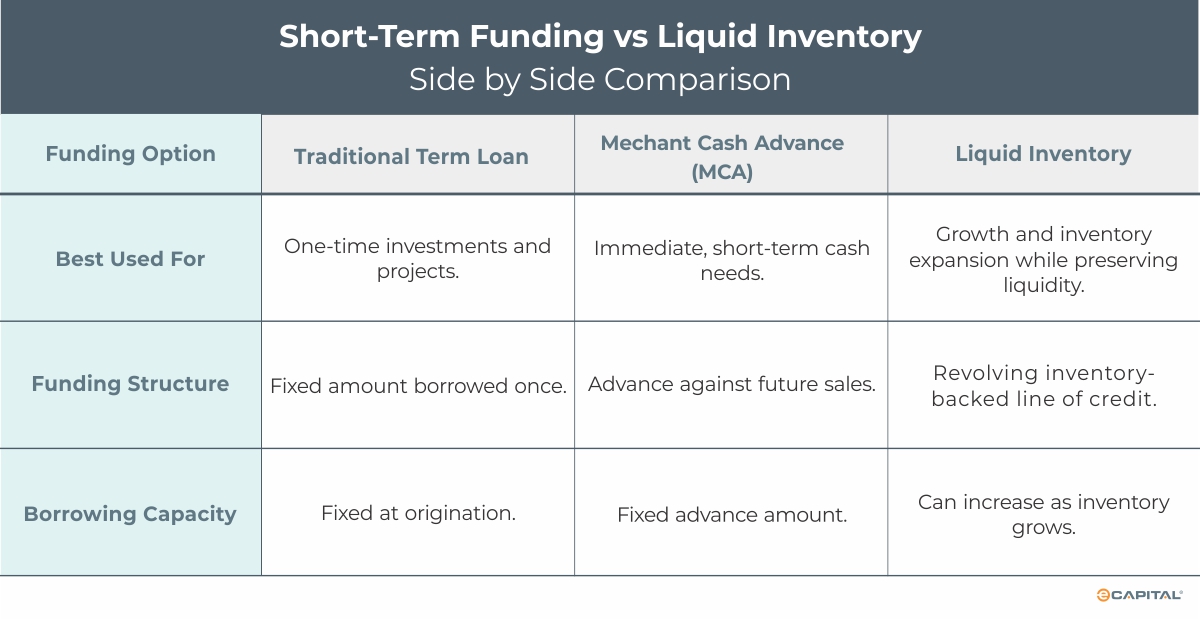
If the primary objective is purchasing inventory and supporting ecommerce growth, Liquid Inventory may provide a more targeted solution.
When Short-Term Funding Is the Better Fit
The structure of short-term funding typically performs best when the funding need is temporary, project-specific, or unrelated to inventory growth.
Short-term funding may be the better option for Amazon sellers when:
- Funding a one-time business initiative such as a new product launch or a software investment.
- Managing unexpected expenses such as legal fees, or an unexpected tax bill.
- Consolidating several smaller debt obligations into one manageable facility.
- Financing a hiring campaign or business facility improvements.
In these situations, the traditional lending structure of a line of credit or short-term business loan may make more sense than an inventory-focused solution.
When Liquid Inventory Is the Better Fit
Liquid Inventory may be a stronger choice when growth depends on maintaining adequate inventory levels, funding larger purchase orders, or preserving working capital as inventory requirements increase.
Common use cases include:
- Maintaining inventory levels across fulfilment centers to meet ongoing demand
- Funding larger supplier orders
- Expanding into new markets
- Supporting seasonal inventory builds
- Increasing SKU count
- Reducing the risk of stockouts during high-demand periods
- Maintaining consistent cash flow despite delayed payout cycles
This structure offers a strategic approach for sellers experiencing rapid growth. Rather than depleting cash reserves to invest in inventory, businesses can preserve liquidity while maintaining product availability.
How to Choose the Right Option for Your Business
Choosing the right Amazon seller financing option depends largely on knowing why capital is needed and following a structured evaluation framework to make funding decisions.
Consider the following questions:
- Is the funding need primarily inventory-related?
- How predictable are future sales volumes?
- Are inventory purchases becoming larger over time?
- Is working capital being consumed by stock purchases?
- Does the business need flexible funding for multiple purposes?
Many growing Amazon businesses ultimately use different financing tools for different objectives. A short-term funding solution may help manage operational expenses, while a dedicated inventory financing facility supports ongoing inventory growth.
The most effective financing strategy is often the one that aligns closely with the underlying business need.
Common Questions About Amazon Inventory Financing
Can you finance inventory?
Yes. Inventory financing is a mainstream funding structure that allows businesses to obtain working capital based on inventory assets or inventory purchases. It is a commonly used Amazon seller financing strategy to fund stock acquisition and growth. Liquid Inventory is a specialized form of inventory financing tailored to meet the demands of ecommerce selling.
Does Amazon offer a line of credit?
Amazon offers financing through Amazon Lending and a network of third-party lending partners. Eligibility is determined by Amazon, and financing offers are typically available by invitation only. Program details can vary based on seller eligibility and marketplace requirements.
Can I borrow money from Amazon?
Some sellers may receive loan opportunities through Amazon Lending programs. Eligibility and available funding options are determined by a variety of factors established by Amazon and its participating lending partners.
How quickly can financing be obtained?
Funding timelines vary significantly depending on the provider, the financing structure, and the application requirements. Sellers should evaluate speed alongside factors such as flexibility, borrowing capacity, and long-term business fit when comparing financing options.
Conclusion
Choosing between short-term funding and Liquid Inventory comes down to the purpose of the capital. Short-term funding may suit temporary or project-specific needs, while Liquid Inventory provides a more scalable, revolving inventory backed Amazon seller financing solution designed to support inventory growth and preserve liquidity as a business scales. By aligning the financing structure with the underlying business need, Amazon sellers can preserve cash flow and invest in growth with greater confidence.
Contact us today to learn whether short-term funding or Liquid Inventory is the right financing solution to support your Amazon business goals and growth strategy.
Key Takeaways
- Amazon sellers often experience rising sales while simultaneously facing greater pressure on working capital as payout cycles lag.
- This lag often creates a cash flow gap.
- Managing this gap requires a constant balancing act between investing in inventory and preserving liquidity.
- In many cases, external financing becomes a practical tool for maintaining momentum and supporting growth.
- A short-term funding solution may help manage operational expenses, while a specialized Amazon seller financing facility, such as Liquid Inventory, provides a revolving inventory-backed line of credit designed to support inventory growth and preserve liquidity as inventory needs increase.
ABOUT eCapital
At eCapital, we accelerate business growth by delivering fast, flexible access to capital through cutting-edge technology and deep industry insight.
Across North America and the U.K., we’ve redefined how small and medium-sized businesses access funding—eliminating friction, speeding approvals, and empowering clients with access to the capital they need to move forward. With the capacity to fund facilities from $5 million to $250 million, we support a wide range of business needs at every stage.
With a powerful blend of innovation, scalability, and personalized service, we’re not just a funding provider, we’re a strategic partner built for what’s next.