
As the new year begins, trucking companies are navigating an industry working to recover from 13 straight quarters of soft demand, depressed rates, overcapacity, and rising costs. Analysts expect the market to rebalance gradually, with demand strengthening in the second half of 2026. However, volatility, cost pressures, and operational inefficiencies will continue to challenge carriers of all sizes.
Knowledge of how competitors, other carriers, and brokers have navigated the past year helps inform smarter financial decisions. It provides benchmarks for pricing, cost control, and liquidity management that are critical to sustaining operations as the market stabilizes.
eCapital, a leading transportation financing company, surveyed its account managers who work directly with thousands of trucking companies across North America. Their insights reveal a sector that is strained, cautious, but still rich with opportunity for carriers ready to adapt.
This article presents information gathered from our experienced team, which represents a cross-section of trucking clients across the industry. It is noteworthy that most account managers (76.32%) include women-owned trucking companies in their portfolio, indicating the growing role of women in commercial transportation. Also, 15.62% of the account managers surveyed include veteran-owned operations among their list of clients, underscoring the breadth of ownership profiles in the trucking sector.
Results point to three defining themes shaping the path to growth in 2026:
- Ongoing financial stress
- Rising operating costs
- Uneven readiness for technology-driven efficiency
This article combines survey results with industry projections to paint a clear picture of what fleets must prioritize to compete and grow in the year ahead.
Financial strain remains despite early signs of rebalancing
While freight markets have shown early signs of rebalancing, the survey reveals that trucking companies are still dealing with persistent cash flow pressure.
Survey result: 97.44% of account managers report that the primary financial problems carriers bring to them involve cash flow issues such as payroll, repairs, or covering operating expenses.
- This aligns with broader market data showing that extended payment terms, delayed shipper payments, and tight margins continue to weigh on small and mid-sized fleets.
- Invoice activity further reflects this strain. Although some fleets reported slight increases in invoice volumes, the majority (over 81.57%) experienced flat or declining invoice activity over the past year.
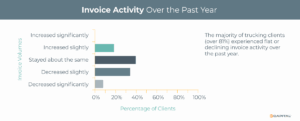
Cash flow constraint is a prevailing industry challenge, even at the best of times. With industry expectations that meaningful freight recovery won’t strengthen until mid-2026, carriers must manage several more quarters of subdued demand that intensifies cash flow pressure.
Yet there is resilience when support structures are in place.
Survey result: 69.23% of account managers said eCapital’s fast response was instrumental in helping their trucking clients overcome disruption when financial issues arose.
- Partnering with an industry-experienced lender and having access to flexible funding remain key lifelines for carriers.
Sentiment heading into 2026: caution, concern, and determination
When asked how clients feel about their 2026 outlook, account managers noted a broad mix of emotions, but optimism remains limited.
Survey result: While 26.32% of fleets described themselves as cautiously optimistic, 18.42% have a neutral outlook for 2026. Meanwhile, 52.63% expressed either concern or mixed feelings about the year ahead.
- This emotional landscape mirrors market forecasts: trucking companies expect another year of tight capacity, aggressive bidding, and inconsistent freight demand.
A cautious mindset is understandable, but it also signals that many fleets will need support, planning, and financial stability to capitalize on opportunities as market conditions begin to improve.
Operating costs are the biggest barrier to growth
The survey results make one point unmistakably clear – rising operating expenses pose the greatest threat to carrier profitability.
Account managers were asked to identify the top three operational challenges faced by their clients. Below are the combined results:
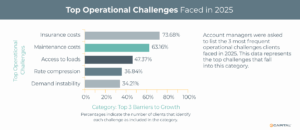
These numbers reflect the harsh reality carriers have managed for several years: premiums have soared, parts and labor for equipment repairs are more expensive, and freight rates remain depressed. Even when freight demand increases in late 2026, fleets will need to rebuild the margins that have eroded over several years.
Multiple recurring expenses are a significant contributor to operational challenges. Account managers report that most fleets struggle with not one, but several repetitive costs.
Here’s a breakdown of the percentage of trucking companies expressing difficulty in managing each of the following recurring expenses:
- Fuel: 78.38%
- Insurance: 64.86%
- Maintenance: 35.14%
- Payroll: 45.9%
For many small carriers, one unexpected repair or a spike in fuel prices can have a significant negative impact on financial health. This underscores how essential reliable working capital and better financial planning will be in the months ahead.
Technology readiness: many fleets are still lagging
While the industry is rapidly moving toward more digital, data-driven operations, survey results show most carriers have yet to fully adopt the tools that drive efficiency and profitability.
Survey result: Two-thirds of account managers say fewer than 25% of their clients are high adopters of technology tools such as TMS platforms, fleet-management systems, and telematics.
That means the majority of carriers still rely on:
- Manual processes
- Standalone apps
- Limited visibility into real-time costs and route efficiency
- Minimal automation for billing or dispatch
As the market becomes more competitive in 2026 and freight volumes begin to recover, carriers that use technology effectively will have a distinct advantage. Digital tools will help them identify profitable loads faster, control fuel and maintenance costs, streamline dispatch, and reduce administrative delays.
Crisis support: enhancing resilience
A notable finding is the number of account managers who have recently supported fleets through severe financial crises or distress.
Survey result: 34.21% of account managers report helping three or more trucking clients through a significant financial crisis, such as potential insolvency or bankruptcy, during 2025. In total, 71.05% of the managers supported at least one client through financial distress.
- This is a sign of the cumulative pressure trucking companies have faced during the freight recession since 2022.
For fleets planning for 2026, this trend is a reminder – resilience must be built before growth can occur.
Encouraging signs: growth is happening with the right support
Despite industry-wide challenges, a significant number of trucking companies, aided by flexible financial support, have managed to grow since becoming an eCapital client:
Survey result: All account managers reported that at least some of their clients experienced growth despite economic and market pressures. Among them, one-quarter of managers indicated that 25% to more than 50% of their clients achieved measurable growth, even amid industry challenges.
- This shows that even in a tough market, fleets can expand with the right mix of:
- Consistent cash flow
- Access to capital for repairs, payroll, and fuel
- Better load selection
- Stronger operational control
-
- Partnerships that deliver financial stability
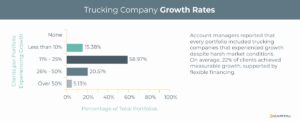
The companies that are growing today are likely the best-positioned for the 2026 recovery cycle.
What this means for trucking companies preparing for 2026
Bringing the data together with industry projections, three strategies stand out for fleets that want to grow next year:
- Focus on cash flow stability above all else
With freight rates still inconsistent and operating costs high, predictable cash flow is the foundation fleets need to survive early-2026 and capitalize on late-2026 demand improvements. Access to immediate working capital allows fleets to:
- Take better loads
- Cover fuel without delay
- Pay drivers consistently
- Manage rising insurance and repair costs
- Avoid crisis-driven decisions
- Invest in operational efficiency
Even small improvements (digital dispatch tools, load-tracking apps, maintenance scheduling software) can reduce costs and create competitive advantages. As freight markets rebound, efficient carriers will capture more freight and operate with stronger margins.
- Build flexibility into financial planning
Tariffs, fuel volatility, regulatory changes, and seasonal freight shifts will continue to create uncertainty. Flexible financing solutions, such as freight factoring, asset-based lending (ABL), and fuel discount programs, give fleets the agility to adjust quickly, navigate disruptions, and pursue growth opportunities as they emerge.
Conclusion
The survey results align with forecasters’ projections for the trucking industry in 2026: the road to recovery will be uneven, but opportunities will be significant for fleets that are financially prepared and operationally adaptable.
Carriers that stabilize cash flow, adopt smarter tools, and build flexibility into their business models will be ready to navigate the volatility of early 2026 and grow as the market rebounds.
Contact us to build the cash-flow stability and financial flexibility your fleet needs to compete and grow in the next phase of freight recovery.
Key Takeaways
- Analysts expect the freight market to rebalance gradually, with demand strengthening in the second half of 2026. However, volatility, cost pressures, and operational inefficiencies are expected to continue challenging carriers of all sizes.
- This article combines survey results from an experienced transportation financing team with industry projections to provide a clear view of what fleets must prioritize to compete and grow in the year ahead.
- Together, the data and industry outlook reveal three key growth strategies for trucking fleets preparing for the 2026 market cycle.
ABOUT eCapital
At eCapital, we accelerate business growth by delivering fast, flexible access to capital through cutting-edge technology and deep industry insight.
Across North America and the U.K., we’ve redefined how small and medium-sized businesses access funding—eliminating friction, speeding approvals, and empowering clients with access to the capital they need to move forward. With the capacity to fund facilities from $5 million to $250 million, we support a wide range of business needs at every stage.
With a powerful blend of innovation, scalability, and personalized service, we’re not just a funding provider, we’re a strategic partner built for what’s next.