
Profitability isn’t determined by how many trucks you own – it’s determined by how effectively you use them. Trucks that sit idle, run empty miles, or operate inefficiently drain cash faster than almost any other part of the business. Maximizing equipment utilization is one of the most important operational levers to grow and protect fleet margins. Without effective management, poor equipment utilization can turn even a busy operation into a cash-strapped one.
Financial stability and disciplined equipment management are essential to every successful trucking business. This article is part of a guide designed to provide fleet owners and managers with actionable financial strategies to enhance operational reliability and profitability.
About the guide: A Trucker’s Guide to Cash Flow Management is a strategy blueprint and best-practice resource designed to help fleet owners and managers optimize working capital, control costs, and build financially resilient operations that keep trucks moving and business profitable.
This article breaks down what equipment utilization really means, why underutilized assets are so damaging to margins, and how cash flow constraints often sit at the center of the problem. Most importantly, it explains how smarter access to working capital helps trucking companies keep equipment rolling, without taking on unnecessary risk.
What Equipment Utilization Really Means in Trucking
Utilization isn’t about running equipment into the ground; it’s a balance of workload, maintenance, and cost structure so equipment can be deployed repeatedly and profitably over time. The goal isn’t maximum miles or hours – it’s sustained, profitable use without eroding the asset or the business supporting it. At its core, equipment utilization measures how effectively your trucks and trailers are being used to generate revenue.
In practical terms, it comes down to:
- Revenue miles vs. idle miles
- Loaded time vs. parked time
- Available equipment vs. deployable equipment
The concept is simple, but execution is difficult. A truck that runs 2,500 paid miles per week is far more productive than one that runs 1,800. When a truck sits idle, revenue stops, yet it continues to incur fixed costs such as insurance, permits, and equipment payments.
Utilization is about keeping assets consistently available, reliable, and able to generate revenue at or above breakeven, not just stay busy.
Why Underutilized Trucks Destroy Margins
Margins in trucking are thin. When utilization drops, fixed costs get spread across fewer revenue miles, and profitability erodes quickly.
Underutilized equipment leads to:
- Higher cost per mile
- Lost revenue opportunities
- More stress on cash flow
- Reactive decision-making
There are only three levers to improve profits in the trucking industry:
- Raise rates
- Drive more revenue generating miles
- Control costs
A truck that sits idle for three days due to a repair delay or lack of fuel money doesn’t just miss out on generating revenue miles, it continues to accrue fixed costs, negatively impacting two of the three profit levers. Multiply that across a fleet, and small inefficiencies turn into systemic margin pressure.
The Most Common Equipment Utilization Killers
Most utilization problems don’t start with dispatch mistakes. They start with cash flow constraints that ripple through operations.
- Cash Flow Delays
The gap between delivering a load and systemic payment delays is one of the biggest threats to utilization.
When cash is tied up in receivables, fleets may struggle to:
- Cover fuel for the next run
- Pay for routine maintenance
- Handle unexpected repairs
- Take on higher-paying loads that require upfront costs
Even profitable operations can be forced to park equipment while waiting on customer payments.
- Deferred Maintenance
Maintenance delays are a common mistake and one of the fastest ways to lose utilization.
Common scenarios include:
- Skipping preventive maintenance to conserve cash
- Running worn tires longer than planned
- Delaying emissions or compliance repairs
Deferred maintenance may start as a short-term cash decision to save costs, but often turns into longer downtime, higher repair bills, and lost revenue.
- Fuel Constraints
Fuel is a daily operating requirement, not a negotiable expense.
Cash-constrained fleets may be unable to buy the fuel needed to haul a load or absorb the additional costs when prices spike. Limited access to funds may limit purchasing options on the road or force your trucks to miss loads due to inadequate fuel purchasing power.
When fuel access is inconsistent, utilization suffers, even if freight demand is there.
- Driver Shortages and Turnover
Idle trucks often come down to people, not freight. The driver shortage, and frustrated operators are a significant contributor to poor equipment utilization.
Cash flow affects drivers more than many operators realize:
- Late pay checks and poorly maintained equipment frustrates drivers, and rank high on the list of reasons for high driver turnover rates.
- Inconsistent miles due to inadequate operating budgets reduce driver confidence, patience, and productivity.
Reliable cash flow supports predictable drivers’ pay, better equipment uptime, and stronger retention – all of which keep trucks moving.
- Poor Dispatch and Load Planning
Dispatch efficiency is often constrained by cash flow. Without adequate working capital, fleets may be forced to:
- Accept lower-paying loads just to keep moving and generate cash flow
- Deadhead longer distances to chase cash-friendly freight
- Decline profitable opportunities that require upfront expenses
How Utilization Challenges Look at Different Fleet Sizes
Owner-Operators: For owner-operators with just one truck, utilization is personal. A parked truck means zero revenue. Even one week of downtime can set off months of financial recovery.
Small Fleets (2–10 Trucks): At this stage, problems compound. Utilization challenges often include staggered maintenance that takes multiple trucks offline and difficulty absorbing breakdowns without disrupting dispatch. One truck down can affect the productivity of the entire operation.
Growing Fleets (10–50 Trucks): Larger fleets face utilization risks that stem from scale – more trucks create more points of failure. Maintenance must be coordinated across dozens of units, fuel costs rise significantly, and more cash is tied up in receivables at any given time. When one issue occurs, such as a delayed payment, parts shortage, or scheduling breakdown, it can affect multiple trucks at once. Even with strong freight demand, these operational and financial pressures can reduce uptime and leave equipment underutilized.
Monitoring utilization to protect profitability
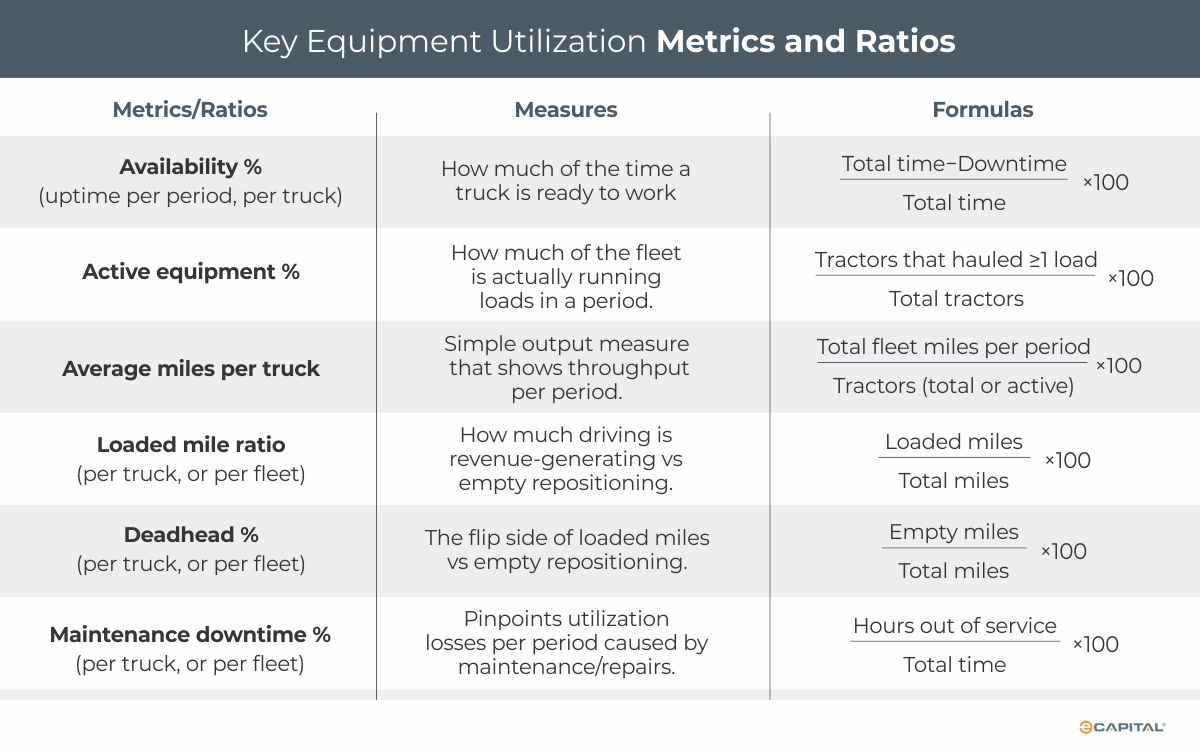
Regular monitoring of key equipment utilization metrics and ratios is recommended to support dispatch and maintenance decisions that improve uptime, reduce deadhead, and protect profitability.
How cash flow impacts utilization
Cash flow is the hidden lever behind utilization – it is a key determinant of whether trucks are deployable when freight is available. Even profitable fleets can be forced to park equipment if cash is tied up in unpaid invoices. Without timely access to working capital, maintenance gets delayed, fuel purchases become constrained, drivers sit idle, and dispatch options narrow. When cash flow is predictable, fleets can keep trucks fueled, serviced, staffed, and moving – turning available freight into consistent revenue miles rather than missed opportunities.
How Specialty Financing Supports Higher Utilization
Trucking companies typically have limited sources of financing to support operations because the industry’s cash flows are volatile, asset-heavy, and often misunderstood by traditional lenders. Fortunately, specialty lenders, experienced in transportation financing fill the credit gap with flexible funding solutions that align cash availability with the real operating cycles of trucking businesses.
Specialized cash flow options, tailored to meet the demands and capabilities of hard working trucking operations include:
- Freight factoring, which converts invoices into immediate cash
- Asset-based lending (ABL), which provides revolving access to capital tied to receivables or equipment
- Fuel discount programs, which reduce per-gallon costs, smooth cash outlays, simplifies cost control, and streamlines reporting.
These tools provide consistent access to cash, enabling fleets to keep trucks fueled, perform maintenance on schedule, pay drivers reliably, and accept profitable loads without hesitation. Instead of parking equipment while waiting on payments, operators can keep trucks moving, protect margins, and scale utilization safely as demand returns.
The Connection Between Utilization and Safer Growth
High utilization without financial discipline often leads to burnout – it pushes equipment, drivers, and cash flow beyond sustainable limits.
Running trucks nonstop without adequate cash reserves often results in deferred maintenance, higher breakdown rates, driver fatigue, and reactive decision-making. Over time, what looks like strong utilization turns into rising costs, safety risks, and operational strain. Instead of building sustainable growth and long-term success, high utilization without adequate financial support undermines profitability and forces fleets into costly downtime.
The most resilient fleets don’t chase nonstop movement – they build systems that keep trucks moving consistently and profitably.
Conclusion
Equipment utilization is not just an operational challenge – it is a financial one. Keeping trucks moving consistently and profitably depends on having the cash flow to support fuel purchases, maintenance schedules, driver pay, and smart dispatch decisions. When working capital is predictable, fleets gain the flexibility to deploy equipment when freight is available, rather than when cash allows.
Effective cash flow management turns utilization from a constant struggle into a controllable advantage. By aligning financial strategy with operating reality, trucking companies can reduce downtime, protect margins, and grow safely – ensuring that trucks, drivers, and capital are all working in sync. In a market where efficiency separates survivors from leaders, disciplined cash flow is what keeps fleets resilient, responsive, and ready for what’s next.
Contact us to explore practical cash flow solutions that help maximize equipment utilization and support sustainable fleet growth without adding unnecessary risk.
Next in the series
Strategic Load Acquisition – Building Long-term Resilience in Challenging Conditions
- Low-growth markets do not eliminate opportunity – they reshape it.
- Chasing every available load often backfires, driving up fuel spend, increasing deadhead, accelerating equipment wear, and reducing revenue per mile.
- Resilient trucking companies shift focus from total loads hauled to load quality.
- By prioritizing load quality, strengthening relationships, optimizing lanes, and aligning freight decisions with cash flow realities, trucking companies can stabilize volume and protect profitability even in challenging conditions.
- This article presents five load acquisition strategies designed to build long-term resilience in challenging conditions.
View the complete Table of Contents.
Key Takeaways
- Maximizing equipment utilization is one of the most important operational levers to grow and protect fleet margins.
- Resilient fleets don’t chase nonstop movement – they build systems that keep trucks moving consistently and profitably.
- Most utilization problems don’t start with dispatch mistakes. They start with cash flow constraints that ripple through operations. Cash flow is a key determinant of whether trucks are deployable when freight is available.
- By aligning financial strategy with operating reality, trucking companies can reduce downtime, protect margins, and grow safely – ensuring that trucks, drivers, and capital are all working in sync.
ABOUT eCapital
At eCapital, we accelerate business growth by delivering fast, flexible access to capital through cutting-edge technology and deep industry insight.
Across North America and the U.K., we’ve redefined how small and medium-sized businesses access funding—eliminating friction, speeding approvals, and empowering clients with access to the capital they need to move forward. With the capacity to fund facilities from $5 million to $250 million, we support a wide range of business needs at every stage.
With a powerful blend of innovation, scalability, and personalized service, we’re not just a funding provider, we’re a strategic partner built for what’s next.