

TL;DR
For trucking fleets, fuel payment strategy directly impacts cash flow, profitability, and operational control. While traditional credit cards and credit lines provide flexible access to capital, they often increase total fuel costs through higher pump pricing, interest charges, and limited spend visibility. Fuel card programs are specifically designed for fleet operations, offering fuel discounts, real-time tracking, spending controls, fraud protection, and improved cash flow management. By lowering fuel costs at the point of purchase and providing greater operational visibility, fuel cards help fleets operate more efficiently, protect margins, and strengthen long-term financial performance.
One of the golden rules in trucking cost management is to “control what you can.” While you can’t control fuel prices, you can control how and when you pay for fuel – and that decision directly impacts cash flow, cost structure, and financial flexibility.
With a fleet’s constant need for working capital, choosing the right fuel payment method is more than an accounting function – it’s a core cash flow strategy. Two common options are traditional credit lines (or credit cards), and dedicated fuel card programs.
This article focuses specifically on how these payment methods differ in cost, control, and cash flow impact – and what that means for fleet performance.
Fuel expenses create a structural cash flow gap
Protecting margins and improving cash flow is essential for sustainability and profitability. Beyond fluctuating fuel prices, the way fuel is paid for introduces hidden financial trade-offs – interest costs, pricing differences, repayment timing, and limited visibility.
Fuel is one of the few expenses that is:
- High frequency (daily or near-daily purchases).
- Operationally critical (delayed fueling impedes fleet movement).
- Paid before revenue is collected.
This creates a structural cash flow gap that must be managed carefully.
Choosing the wrong payment method can quietly:
- Increase effective fuel costs.
- Accelerate cash outflows.
- Reduce visibility and lead to potential overspending.
How payment method impacts liquidity
Route optimization and fuel efficiency reduce consumption – but payment structure determines how fuel impacts liquidity. For most fleets, traditional credit options (credit lines or credit cards) and dedicated fuel card programs are the primary solutions for managing fuel expenses, but they offer very different levels of control, cost savings, and operational efficiency.
At a high level, the trade-off looks like this:
- Traditional credit options = flexible access to capital but come with higher costs and less control.
- Fuel cards = optimized fuel purchasing with embedded savings and tighter cash flow management.
The key difference is not just how you pay – but how each method shapes your cash flow cycle. Let’s take a closer look at these two options to compare their features, benefits, trade-offs, and ultimately determine which is better for your trucking fleet.
Traditional credit options (credit cards & credit lines)
Credit cards and credit lines provide fleets with flexible access to funds, broad acceptance, and deferred payments.
Features and benefits of traditional credit options include the following:
- Revolving source of funds
Allows fleets to purchase fuel even when cash on hand is limited. - Widespread Acceptance
Major credit cards are accepted at virtually every fuel stop, making them convenient for long-haul routes across various regions. - Deferred Payments
Allows fleets to bridge the gap between fuel purchases and customer payments. - Simple Setup
Traditional credit options are easy to apply for, quick to deploy, and can be used immediately once approved.
The cash flow trade-offs of traditional credit options include the following:
- Higher effective cost of fuel
The price of fuel that’s posted on the big sign in front of a truck stop is the cash price. The pump price for diesel is much higher when paying by credit card. (typically an additional 5¢ to 10¢/gallon). - Interest expense on revolving balances
If not paid in full, borrowing costs compound quickly. - Repayment timing
Credit card payments follow fixed billing periods and due dates that don’t adapt to real-time cash flow. - Limited spend controls
Harder to restrict usage by driver, vehicle, or fuel type. - Low visibility into real-time fuel spend
Delays in reporting and limited transaction details reduce the ability to react quickly.
While traditional credit options improve short-term liquidity, they often introduce long-term cash flow inefficiencies and higher total fuel costs.
The rewards program trap
Some commercial credit cards offer cash back or points-based rewards, which can seem highly beneficial – but they rarely offset the added fuel markup of 5–10¢ per gallon for credit card purchases.
Consider the cost versus what you are rewarded:
- Credit card markup (5–10¢/gal) = ~1.7%–2.5% cost increase (at ~$3–$4 diesel)
- Rewards earned (~1–2%) = does not offset the higher price
Net result: credit cards often cost more than they return, even before interest.
Fuel Card Programs
Like traditional credit options, discount fuel cards are simple to set up, are widely accepted, and let you “fuel now, pay later” with a revolving source of credit – a significant advantage for managing cash flow. However, fuel cards are specifically designed for the transportation industry, offering lower fuel costs, greater control, enhanced security, and trucking-specific features.
Unique features tailored to fleet operations include:
- Fuel discounts at major truck stops nationwide.
- Real-time expense tracking and reporting.
- Driver-specific controls and purchase limits.
- Centralized management into a single, easy-to-manage account.
Leading fuel card programs provide additional perks, including:
- No monthly or annual fees
The program is designed to be cost‑effective even for small operations. - Improved tax preparation
Better visibility and reporting enable quick IFTA submissions and, if required, the calculation of carbon taxes or environmental levies. - Increased security measures
Track spending and set purchase limits by driver or vehicle through a centralized account. Receive alerts for any deviation to mitigate fraud risk. - Real-time data visibility
Immediate insight into spend enables improved expense forecasting and faster operational decisions. - Integrated fuel finder
Plan ahead and save more. Know where to find the best discounts along the lanes you run with real-time fuel pricing built right into your portal.
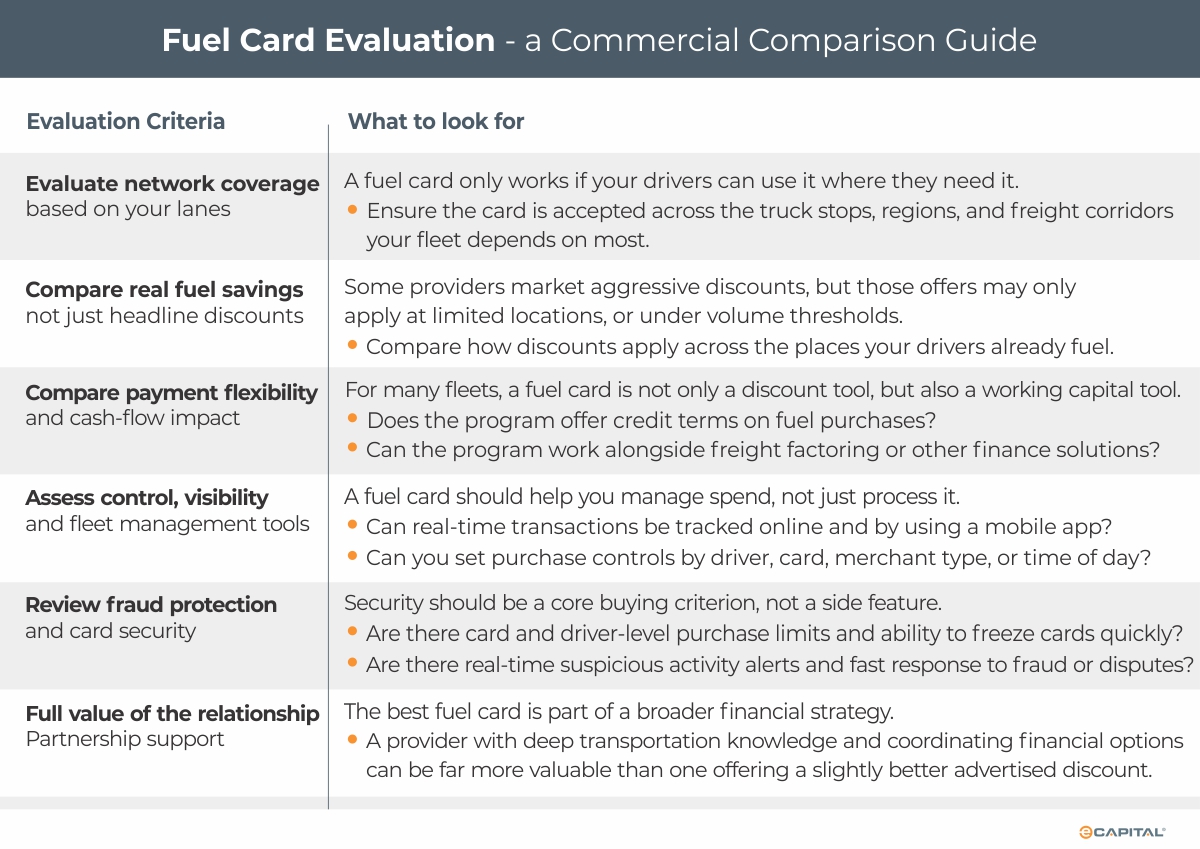
How to choose the best fleet fuel card
Be careful when choosing the right card for your trucking company, and do a fleet fuel card comparison. Only a few suppliers carry all the benefits of a quality fuel discount card.
Whether you have one truck or a fleet of 300+ trucks, the best fuel discount card programs provide immense value to benefit your bottom line. Look for a card that offers:
- Huge savings off the cash price
- No transaction fees
- Credit terms on fuel purchases
- Accepted at major full-service truck stops across North America
- Easy qualification for any size fleet
- Card security, monitoring and control
- View all transactions in real time
- Easy-to-understand reporting
Conclusion
Trucking fleets must do more than manage fuel costs – they must manage how those costs impact cash flow efficiency and operational discipline.
Traditional credit provides flexible access to funds but often increases total fuel costs through higher pricing and interest, while offering limited visibility and control. In contrast, fuel cards reduce cost at the point of purchase (via cash pricing and discounts), provide real-time tracking, and enforce spend controls. These features result in lower cost per mile, more predictable cash flow, and tighter operational management, all of which contribute to stronger, more scalable fleet performance.
When evaluated purely as payment methods, fuel cards outperform traditional credit by aligning cost, timing, and control – three critical drivers of cash flow efficiency. For fleets looking to operate leaner and scale more effectively, choosing the right fuel payment method is not just a financial decision – it’s a competitive advantage.
Contact us to take control of your fuel costs and cash flow. Connect with our team to see how the right fuel payment strategy can help your fleet run more efficiently and profitably.
Key Takeaways
- Fuel payment method directly impacts cash flow – not just convenience.
- Traditional credit offers flexibility but introduces higher costs and weaker control.
- Fuel cards deliver lower fuel costs, better visibility, and structured cash flow management.
- Fuel cards are specifically designed to meet the cash flow challenges of a capital-intensive industry.
- Features include preapproved revolving credit, no monthly or annual fees, simplified tax reporting, stronger spending controls, and real-time visibility to support stronger, more scalable fleet performance.
ABOUT eCapital
At eCapital, we accelerate business growth by delivering fast, flexible access to capital through cutting-edge technology and deep industry insight.
Across North America and the U.K., we’ve redefined how small and medium-sized businesses access funding—eliminating friction, speeding approvals, and empowering clients with access to the capital they need to move forward. With the capacity to fund facilities from $5 million to $250 million, we support a wide range of business needs at every stage.
With a powerful blend of innovation, scalability, and personalized service, we’re not just a funding provider, we’re a strategic partner built for what’s next.